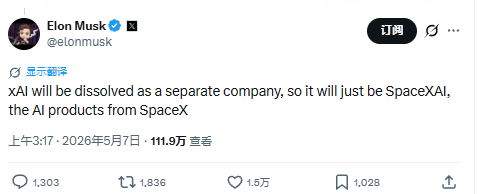
On May 7th, Musk suddenly announced the dissolution of xAI, its merger with SpaceX, and renaming it SpaceXAI. On the same day, SpaceX reached an agreement with Anthropic to lease all 220,000 GPUs and 300 megawatts of computing power from the world’s top supercomputer, Colossus 1, to Claude. The AI landscape changed overnight.
Founded in 2023, xAI initially aimed to compete with OpenAI, and its valuation once reached $250 billion. However, its Grok model consistently failed to challenge the dominance of ChatGPT and Claude, and it suffered annual losses exceeding $10 billion, making independent development unsustainable. This integration marks a crucial turning point for Musk, shifting his focus from “model competition” to “computing power control.”
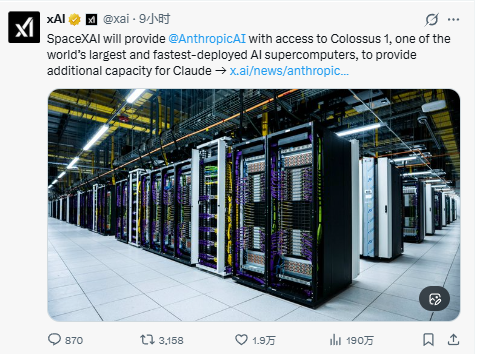
The computing power boost from Colossus 1 allowed Claude to immediately upgrade: code usage limits doubled, peak-hour throttling was removed, and API speeds were significantly improved. Anthropic has thus assembled a top-tier computing power alliance including Amazon, Google, and SpaceX, becoming OpenAI’s strongest competitor. Meanwhile, Musk is simultaneously suing OpenAI and demanding the removal of Altman from his post, while also providing computing power to support his rival—a two-pronged attack on both commercial and legal fronts, a truly ruthless tactic.
This signifies that the focus of AI competition has shifted from models to infrastructure. Musk has abandoned the model battlefield, instead controlling the lifeline of computing power, both hedging against losses in xAI and deeply binding himself to core resources in the AI field. OpenAI is now besieged on all sides, completely rewriting the global AI three-way competition landscape.
The article comes from the Internet. If there is any infringement, please notify me to delete it. Please indicate the source when reprinting!
If you have news to publish, please send it to:article@domain.news