

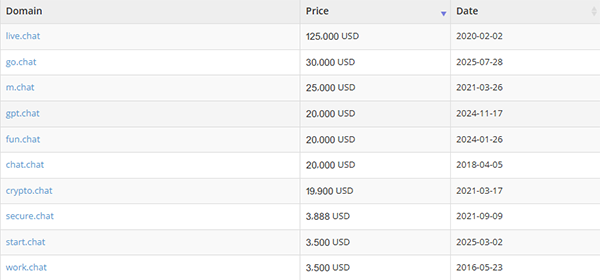
Recently, the domain name “Go・Chat” was successfully traded at a price of $30,000. This transaction price makes it the second highest publicly traded price for .chat suffix domain names, once again focusing people’s attention on the market value of the .chat suffix.


The .chat suffix has a distinct vertical scene orientation, and its semantics directly corresponds to “chat, dialogue”, and has a natural fit with instant messaging, social platforms, AI dialogue systems, customer service tools and other fields. In such a semantic environment, a .chat domain name with a simple structure and clear meaning can often bring higher brand communication efficiency, allowing users to perceive the brand more intuitively.
From the perspective of domain name composition, “go” is an extremely common and vibrant English verb in the Internet field. It is widely used in many scenarios such as travel, entrepreneurship, and calls, and is often associated with meanings such as action and start. When “go” and “chat” are combined, the action command of “start chatting” is directly transmitted, which is not only easy to understand, but also conducive to word-of-mouth communication. Therefore, “Go・Chat” can be regarded as an ideal entry domain name for AI chatbots, social platforms and even game voice services.
Looking back at the public sales records of .chat domain names, the current number one is “Live・Chat”, which was sold for $125,000 in the early years and is still the highest transaction price for this suffix. After “Go・Chat”, which ranked second in this transaction, “M・Chat” ranked third with a transaction price of $25,000, and “GPT・Chat” and “Fun・Chat” both ranked fourth with a price of $20,000.
From these high-priced keywords, it can be found that the market’s recognition of the .chat suffix is mainly concentrated on several types of names: one is short words, clear semantics and strong applicability; the other is related to popular fields such as artificial intelligence and social networks. The successful transaction of “Go・Chat” also proves once again that non-traditional suffixes also have good commercial value in the appropriate application context.
The article comes from the Internet. If there is any infringement, please notify me to delete it. Please indicate the source when reprinting!
If you have news to publish, please send it to:article@domain.news

